Geghard Monastery: The Short Answer
Geghard Monastery is a 13th-century monastery partly carved into the cliffs of the upper Azat gorge, about 40 km east of Yerevan. It is a UNESCO World Heritage Site and still an active church. Entry is free. It takes about 50 minutes to get there by taxi from Yerevan, or you can take minibus 266 to Garni and a short local taxi from there. Plan 1 to 1.5 hours on site, cover your shoulders and knees, and come before 10:00 to have the cave churches to yourself.
This guide covers what Geghard is, its history in three minutes, what to see inside, how to get there, and the best time to visit.
What Is Geghard Monastery?
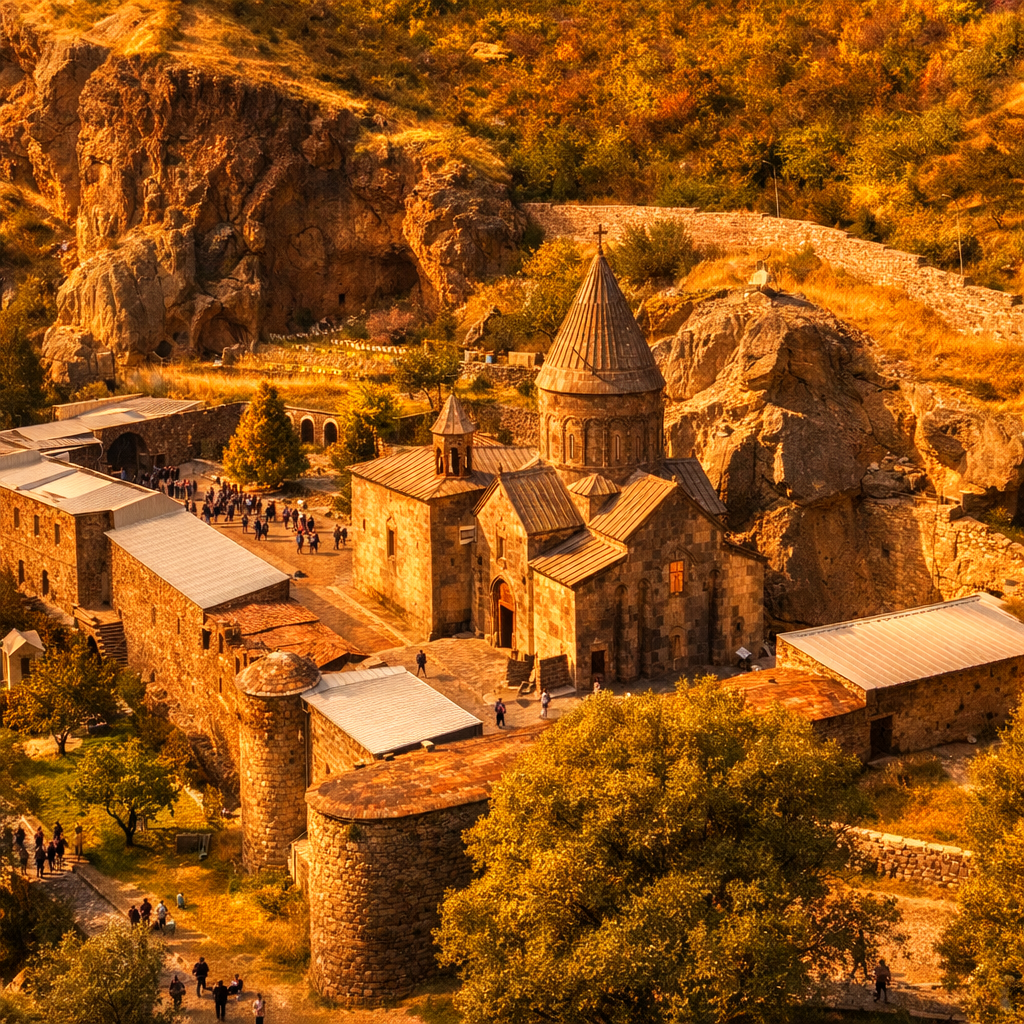
Geghard is a group of churches, chapels and tombs at the end of a narrow gorge, where the road stops against a wall of rock. One church stands in the open. The rest are cut straight into the mountain: whole rooms with domes, columns and carved walls, made by removing stone, not by building with it.
The name means "spear." For about 500 years the monastery kept the Holy Lance, the spear said to have pierced Christ at the crucifixion. In the 13th century it was also called the Monastery of the Seven Churches and the Monastery of the Forty Altars, which gives you an idea of how much is hidden in the rock.
Geghard at a glance
| Location | Near Goght village, Kotayk Province, about 40 km east of Yerevan |
| Founded | 4th century (tradition); main buildings 1215 to 1288 |
| Ticket | Free; donations and candles inside |
| Hours | Daily, roughly from morning until dusk; services on Sunday mornings |
| Time needed | 1 to 1.5 hours |
| Dress code | Shoulders and knees covered; women often cover their hair, scarves at the entrance |
| Getting there | Taxi about 50 min, or minibus 266 to Garni plus a 15-minute taxi |
| UNESCO | World Heritage Site since 2000, with the Upper Azat Valley |
A 3-Minute History of Geghard
A sacred spring in a cave
Long before Christianity, people came to a spring that flows out of a cave in this gorge. Tradition says that Gregory the Illuminator, who converted Armenia to Christianity in 301 AD, founded a monastery here in the 4th century to turn a pagan holy place into a Christian one. It was called Ayrivank, "the monastery of the cave."
Nothing of that first monastery survives. It was raided in the 9th century, and in 923 an Arab governor named Nasr looted it, took its manuscripts and burned the buildings. Earthquakes did the rest.
The Zakarian princes rebuild it
Geghard came back to life when the brothers Zakare and Ivane Zakarian, Armenian generals who served Queen Tamar of Georgia, drove the Seljuks out of northern Armenia. Under them the main church, Katoghike, was finished in 1215, and the large entrance hall in front of it followed by 1225. The small Chapel of St. Gregory, partly cut into the rock, is older still, from before 1177.
The Proshyans carve into the mountain
In the mid-13th century the monastery was bought by Prince Prosh Khaghbakian, head of the Proshyan family, who made it his family's monastery and burial place. That is when the most extraordinary part of Geghard was made. Over about 40 years, stonemasons cut churches and tomb chambers straight into the cliff, ending with a burial hall dated 1283 and an upper chamber dated 1288.
Why "the monastery of the spear"?
The name Geghard first appears in a document from 1250. It comes from the Holy Lance, which tradition says the Apostle Thaddeus brought to Armenia. The relic is no longer at Geghard. It is kept in the treasury of Etchmiadzin Cathedral, west of Yerevan, together with a silver case made for it in 1687. The story of how the spear came to Armenia, and why it ended up here, is one of the best things to hear on site.
What to See at Geghard
The gate, the walls and the cave cells
You enter through a gate in the old defensive wall. Look up at the cliffs on your left: the small square openings are monks' cells, cut into the rock outside the main complex. The historian Mkhitar Ayrivanetsi lived in one of them in the 13th century. The rock faces around the courtyard are covered with carved crosses, some of them khachkars cut directly into the cliff.
Katoghike, the main church
Katoghike is the only church at Geghard that stands free of the mountain, although its back wall leans against it. It has an equal-armed cross plan under a single dome. Above the south door, look for the carving of a lion attacking an ox, an old symbol of power that the Zakarian princes liked to use. The walls are covered with inscriptions and crosses left by pilgrims over 800 years.
The gavit and its stalactite dome
Through the main church you reach the gavit, a large hall where monks taught, met and received pilgrims. Four columns hold up a dome decorated with stone "stalactites," hanging cells of carved stone that catch the light from the opening above. It is considered the finest example of this technique in Armenia. Stand under the opening for a moment and look straight up.
Avazan: the church of the spring
From the gavit, a door on the left leads into the first rock-cut church, carved in the 1240s around the ancient spring. Its architect was a monk named Galdzak, whose name is in an inscription on the wall. Water still runs out of the rock into a small basin. Pilgrims wash their hands and face in it or fill bottles, and many believe it has healing powers.
The Proshyan tomb and its coat of arms
The next chamber, cut in 1283, holds the tomb of Prince Prosh. High on the wall is the Proshyan coat of arms: two lions tied together with a chain, and between them an eagle holding a lamb in its claws. Nobody is certain what it meant to the family, and historians have several theories. Next to it is the Astvatsatsin (Holy Mother of God) chapel, consecrated the same year.
The upper zhamatun and the acoustics
Leave the main building and climb the outside staircase to the left. It leads to a tunnel and then to the upper chamber, carved in 1288 as the tomb of Papak Proshyan and his wife Ruzukan. It is dark and plain, and it has the best acoustics at Geghard. Hum one low note and the room answers back for several seconds. On some days small choirs sing here, and if you hear one, stay.
Ribbons, pebbles and gata
Outside the walls you will see trees covered in strips of cloth and people trying to throw small stones into holes high in the cliff. Both are wish-making customs: if your pebble stays up, your wish comes true. Near the gate, local women sell gata, a sweet Armenian bread, and sujukh, walnuts in grape syrup. You may also see families preparing a matagh, a traditional offering, near the entrance.
Geghard Tickets and Opening Hours
Geghard is an active monastery, and entry is free. Candles are sold inside, and donation boxes help with upkeep. There can be a small parking charge for cars.
The gates are generally open daily from morning until early evening, with longer hours in summer. Exact times are not published officially and can change for services, weddings and church holidays. Sunday mornings have a liturgy, which is a beautiful time to visit as long as you keep quiet and stay at the back.
How to Get from Yerevan to Geghard
By taxi (easiest)
Order a car through the Yandex Go or GG apps. The ride takes about 50 minutes, and the app shows the price before you book. Getting a ride back from Geghard is not easy, since few cars wait at the gate, so either ask the driver to wait or book a driver for half a day and add Garni on the way back.
By minibus and local taxi (cheapest)
There is no regular public transport to the monastery itself. Take minibus 266 from Yerevan's Gai bus station to Garni village, about an hour and around 500 AMD. In Garni, take a local taxi for the last 10 km to Geghard. Drivers wait near Garni Temple, and a round trip with waiting time costs a few thousand dram. Agree the price before you get in.
The full timetable and price breakdown for this route is in our Garni and Geghard day trip guide.
By group tour
Almost every agency in Yerevan sells a Garni and Geghard tour, often with the Symphony of Stones, Lake Sevan or a lavash-baking lunch. It is easy, but you will usually get only 30 to 40 minutes at Geghard, which is not enough to see the rock-cut chambers properly.
By car
The road is paved all the way and ends at a car park just below the monastery. Driving is the best choice if you want to arrive at opening time, before the tour buses.
Best Time to Visit Geghard
- Time of day: Before 10:00 is best. Tour groups usually come to Garni first and reach Geghard late in the morning, so the cave churches are at their quietest early.
- Season: May, June, September and October are the most comfortable. The gorge is cooler than Yerevan in summer. In winter the cliffs are often covered in snow and the monastery is almost empty, but bring good shoes, since the steps can be icy.
- Weekends: Saturdays are wedding days, which are lively but crowded. Sunday mornings have the liturgy.
- Light: The deep gorge loses direct sun early in the afternoon. For photos of the facade in sunshine, come in the morning.
What to Combine with Geghard
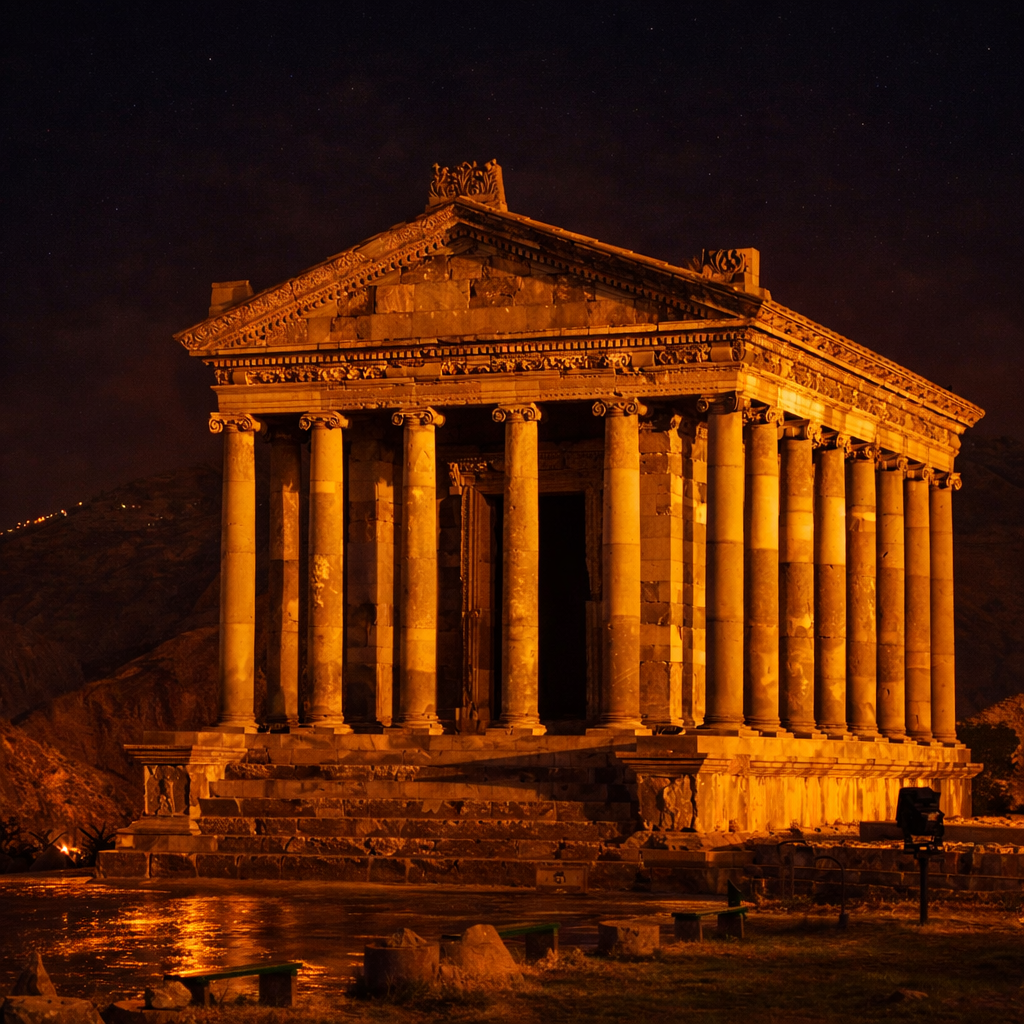
- Garni Temple: A 1st-century Greco-Roman temple to the sun, 10 km down the valley. Read our Garni Temple guide for its history and tickets.
- Symphony of Stones: The gorge of hexagonal basalt columns directly below Garni.
- Charents Arch: A stone arch on the road out of Yerevan with one of the best views of Mount Ararat on a clear morning.
- Lake Sevan: About an hour away, if you want to turn the trip into a full day.
Practical Tips for Visiting Geghard
- Dress modestly. Shoulders and knees covered. Scarves are available at the entrance for women who want to cover their hair.
- Bring a little cash for candles, gata and the taxi from Garni.
- Wear shoes with grip. The stone floors are uneven and smooth from centuries of feet, and the outside staircase is steep.
- Be quiet during services. Ask before photographing priests or people praying, and do not use flash.
- Download your audio guide before you leave Yerevan. Mobile signal is weak or absent inside the rock-cut chambers.
Hear the Story of Geghard Where It Happened
Most visitors walk through Geghard in 20 minutes and leave without knowing which room is which. The GuideMe app has a narrated audio guide for Geghard Monastery, written with local historians. It takes you from the gate to the spring, the Proshyan tomb and the upper chamber, and tells the stories behind the spear, the lions and the people who carved a church out of a mountain.
The guide plays offline and is available in 9 languages. See what the app can do or read the GuideMe app overview.
Planning the rest of your trip? Start with our Armenia travel guide and our list of things to do in Yerevan.
Frequently Asked Questions
Is Geghard Monastery free to visit?
Yes. Geghard is an active monastery and there is no entrance ticket. Candles are sold inside, there are donation boxes, and there may be a small parking charge if you come by car.
How long do you need at Geghard?
One hour is enough for the main church, the gavit, the spring church and the Proshyan tomb. Allow an hour and a half if you also climb to the upper chamber and walk around the cliffs outside.
How do I get to Geghard by public transport?
Take minibus 266 from Gai bus station in Yerevan to Garni village, then a local taxi for the last 10 km. There is no regular minibus to the monastery itself.
Is the Holy Lance still at Geghard?
No. The spear that gave Geghard its name is kept in the treasury of Etchmiadzin Cathedral, west of Yerevan. The monastery kept the name.
What should I wear to Geghard?
Cover your shoulders and knees. Women often cover their hair inside the churches, and scarves are available at the entrance. Wear shoes with good grip for the stone floors and stairs.
Is there an audio guide for Geghard Monastery?
Yes. The GuideMe app includes a narrated audio guide for Geghard Monastery in 9 languages. Download it before you leave Yerevan and it plays offline inside the cave churches.